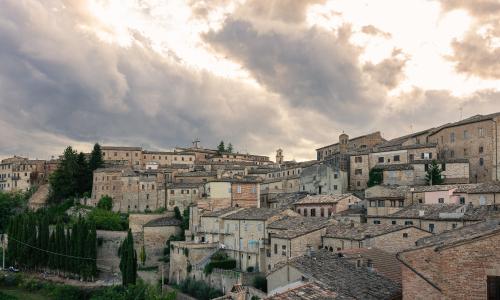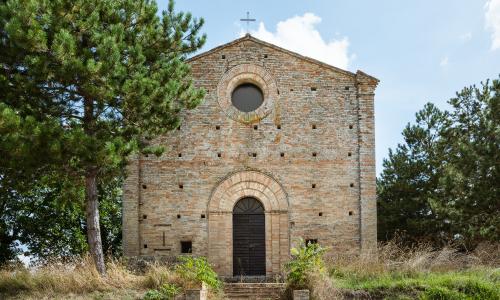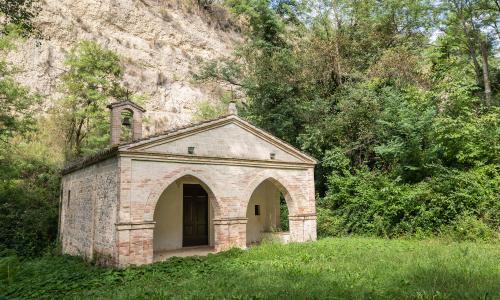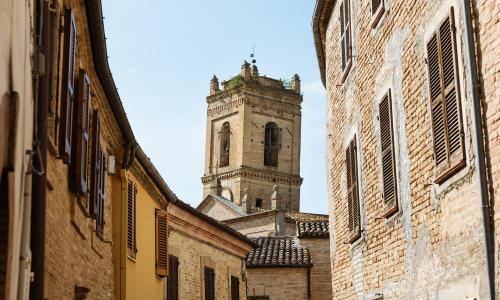


Among the families of this territory most prolific of intellectuals and artists, the Bonfinis were the “ancient dynasties of the land of Patrignone” that is, the lords of the castle, attested in the 13th century under the dominion of Ascoli and ceded by it, precisely, in feud to the Bonfini family. The founder of the family was Achille Bonfini, and it will be in the 15th and 16th centuries that Patrignone wrote the most significant pages of its history, producing monuments and personages of notable stature, almost all of them linked to the noble Bonfini family. Definitely wealthy people to whom it was possible to cultivate the arts, study law and emerge in medicine and literature. The most famous exponent of the family is surely Antonio Bonfini, grandson of Achille, born in 1427. Erudite humanist, after several assignments as a tutor in the most noble families of Ferrara, Rome, Padua and Florence, he came into contact probably in 1476 in Loreto, with Beatrice d’Aragon, wife of Matthias Corvinus King of Hungary. After 10 years from this first meeting, spent as a professor at the Academy of Recanati, he presented his Latin translations of some Greek works and some of his original writings (Symposium sive de virginitate et pudicitia coniugali and a Historia Asculana) to the Hungarian royal family. Matthias Corvinus, charmed by Antonio's wisdom, decided to appoint him as court historiographer, entrusting him with the translation of some Latin writings along with the mighty writing of a history of the Hungarians. The writing of the “Rerum Ungaricum Decades” engaged him until his death in 1502: the work traces the model inaugurated by Titus Livius for the writing of the history of Rome, it consists of five decades ranging from the barbaric people of the Hungarians until the end of 1496. The work is the basis of Hungarian historiography and one of the greatest examples of humanistic literature in this field. Another prominent member of the family is Giacomo Bonfini, son of Antonio, born in 1470. Continuous travels alongside his father between Italy and Hungary enabled him to acquire a solid humanistic education. There is no certain information on his artistic apprenticeship, but on a thoughtful analysis of his works a marked influence of late 15th-century Umbrian-Marchigiana art shines through, with several references to the work of Cola dell’Amatrice and generally of Perugian matrix. Among his most famous works is the pictorial cycle of the Oratory of Our Lady of Mercy in Tortoreto (TE). In the Montaltese territory, the fresco in the crypt of the church of St. Lucia depicting the Nativity stands out, as do those created in his native castle for the churches of S. Maria in Viminatu and dell’Annunziata. Among Giacomo's grandsons there is Martino Bonfini, born in 1565 in Patrignone and a very prolific painter, with works also made in Piedmont and devoted to travels among the capitals of Italian art, in which he learned the main novelties of 16th-century painting. In his paintings it is evident in fact is the influence of Correggio and Parmigianino from Parma, as well as that of Federico Zuccari from Urbino and active in Rome, artists who imprinted Martino’s art with a Mannerist stamp, mediated by a popular characterization. Among his most famous works are the cycle of the Stories of the Virgin in the Sanctuary of the Madonna dell’Ambro in Montefortino, the Marian Cycle in the Church of St. Maria in Pantano and the monumental altar in the Church of the SS.Crocifisso in Monterubbiano. In Patrignone it is possible to admire some of his paintings in the Church of St. Maria in Viminatu. Last but not least, Desiderio Bonfini, a sculptor and woodcarver, among the works that best testify to his art there is certainly the tabernacle in the parish church of Patrignone.