

There is a long-standing tradition regarding the origins of the Sacconi family, although it is not supported by documented evidence. According to this tradition, the family would descend from the Tarlati of Pietramala, lords of Arezzo, with the progenitor Pietro, nicknamed “il Saccone” for having conquered and sacked Città di Castello. In reality, historical documents attest that the family originates from Villa Casale in Montegallo, at the foot of Mount Vettore. The family name, originally a nickname, refers to the “sacconi,” followers of the Ascoli heretic Meco del Sacco.
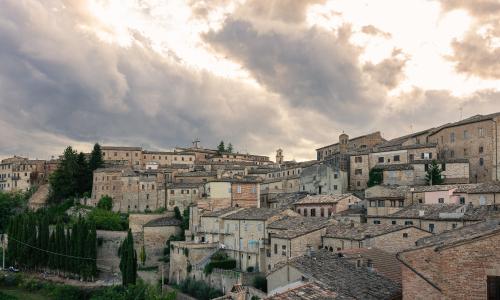
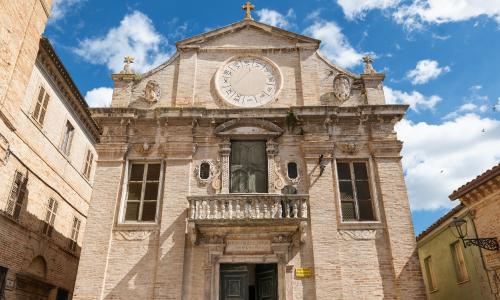
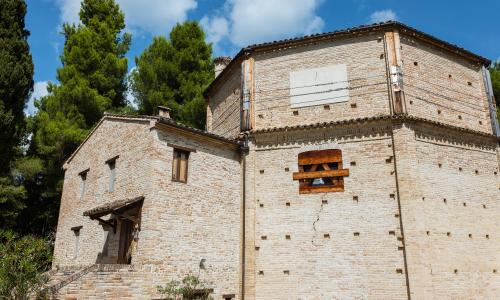
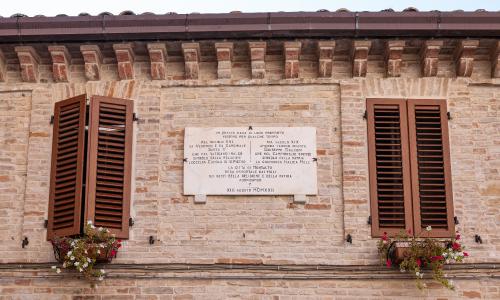
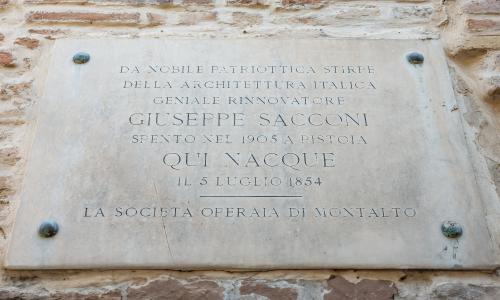
By the early 1600s, the Sacconi were firmly established in Porchia. Many family members held administrative and ecclesiastical offices, and archival records attest to their relentless activity and remarkable economic initiative. Although today there are no longer any descendants of the family living in the town, the memory of the Counts Sacconi remains alive through various traces: street names, the dedication of public and private buildings, the plaque on the birthplace of Giuseppe Sacconi, and the monument dedicated to him in Piazza Umberto I. One of the town’s most imposing buildings, Palazzo Sacconi, also bears the family name.
Among the most notable Sacconi were Count Agostino Rosati-Sacconi, author of a voluminous work recording the genealogy and key events of his family; Cardinal Carlo Sacconi, and his nephew Quintilio Sacconi, who, fascinated by the eloquence and knowledge of the Jesuit fathers, chose to become a miles Christi and, for his entire life, tirelessly served as “Abouna Saroufim,” Father Serafino, among the villages of the rugged mountains of Lebanon and along the blazing roads of Upper Galilee.
However, the most famous Sacconi is undoubtedly Giuseppe, son of Count Luigi and Teresa Massi, the architect of the Altare della Patria. Giuseppe was born in Montalto in 1854 and studied art in Fermo at the renowned Istituto per le Arti e i Mestieri “Montani.” Here, his precocious talent for drawing was nurtured and appreciated by leading figures of Marchigian Neoclassicism: architect Gianbattista Carducci, in whose studio he trained, and sculptor Emidio Paci.
Thanks to these acknowledgments, after completing his studies in the Marche, he enrolled in the architecture program at the Istituto delle Belle Arti in Rome. There, he also lived with his ecclesiastical uncle Carlo Sacconi, a cardinal and former apostolic nuncio to France. In 1874, he received a scholarship from the Pio Sodalizio dei Piceni, an institution supporting talented young people from the Marche who wished to continue their higher education in Rome.
In 1884, he entered the international competition for the National Monument to Victor Emmanuel II in Rome, better known as the Vittoriano or “Altare della Patria.” Sacconi won the competition and from that moment dedicated all his energy to directing the construction of what would become the most important monument of Rome as the new capital of Italy. He oversaw every detail, drawing even the smallest construction and stylistic elements himself. He successfully resolved construction challenges, particularly those caused by the ancient underground cavities in the Capitoline Hill. Construction began in 1885 and occupied him for the rest of his life, with completion coming years after his death. His studio was located inside the monument, in the rooms now housing the Sacrario delle Bandiere. The Vittoriano, with its neoclassical and eclectic style, is now recognized by modern art criticism as an important step in the search for a national style that would characterize the newly established Kingdom of Italy.
Following the Vittoriano project, Giuseppe Sacconi was entrusted with redesigning Piazza Venezia and also designed the tomb of Umberto I at the Pantheon in Rome. In 1891, after a reform concerning the protection of architectural heritage, regional offices for monuments were established; Sacconi directed the Regional Office for Umbria and the Marche for about eleven years, during which he oversaw 111 restoration projects of various kinds, including the Basilica of San Francesco in Assisi and the Basilica della Santa Casa in Loreto. He also played a crucial role in cataloging monuments to provide reliable and updated knowledge of the country’s architectural heritage.
Giuseppe Sacconi died in Collegigliato (Pistoia) on September 23, 1905, from a cerebral hemorrhage. Angelo Conti wrote in Il Marzocco on October 1, 1905: “With Giuseppe Sacconi, the greatest musician of lines of our time has passed away.” Today, in Montalto, a plaque marks his birthplace, and a monument in Piazza Umberto I celebrates his legacy.