

The era of Sisto V was marked by intense religious tensions. In the 1500s, the corruption within ecclesiastical circles, political upheavals, and rivalries created fertile ground for the outbreak of religious conflicts, culminating in the publication of the Lutheran theses and the beginning of the Protestant Reformation. In this challenging context, the Council of Trent slowly got underway, earning Sisto V, among his many titles, the nickname “Pope of the Counter-Reformation.”
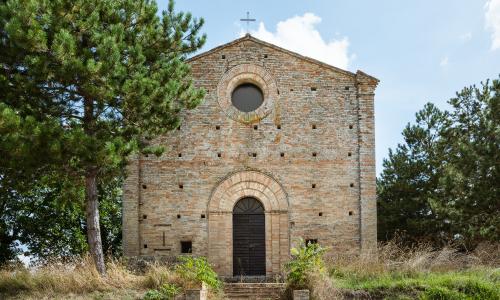
However, if the international scene was far from calm, the local environment in which Sisto was born and grew up was no different. In 1517, the troops of Francesco Maria della Rovere, at war with Pope Leo X, devastated the Piceno region and in June took Montalto, a strategically located town, occupying it for a year. After the war, Piergentile, known as Peretto, the father of the future Pope, was condemned to exile by ecclesiastical authorities, likely for having compromised himself with the Duke of Urbino. Forced into ten years of exile, he moved to Grottammare, and in 1521, following the birth of his first child Camilla, Felice was born.
He grew up in a very poor family, performing humble work alongside his parents. In Montalto, his maternal uncle, Frà Salvatore Ricci, lived in the convent of San Francesco delle Fratte, where he served as Guardian (Superior). At the age of nine, Felice entered the convent and at twelve began his novitiate. In 1535 he donned the Franciscan habit, taking the name Fra’ Felice, and began studying philosophy and theology. In the following years, he gained fame as a preacher in Rome, Perugia, Ascoli, Pisa, and Naples. A charismatic man and a profound theologian, he participated in the preparatory work for the Council of Trent and was appointed Inquisitor of Venice.
In 1567 he was consecrated Bishop of S. Agata dei Goti (BN), and in 1570 he became Cardinal with the title of S. Girolamo degli Schiavoni. In 1585, following the death of Pope Gregory XIII, Fra Felice Peretti was elected Pope, taking the name Sisto V in honor of his fellow Franciscan, Pope Sixtus IV. His pontificate lasted only five years, yet it left an indelible mark. He died on August 27, 1590: his heart was placed in the church of Saints Vincenzo and Anastasio under the Quirinale, while his body was buried in the Vatican.
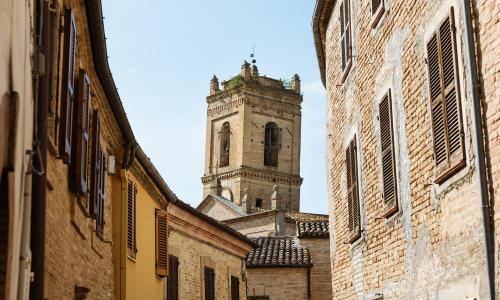
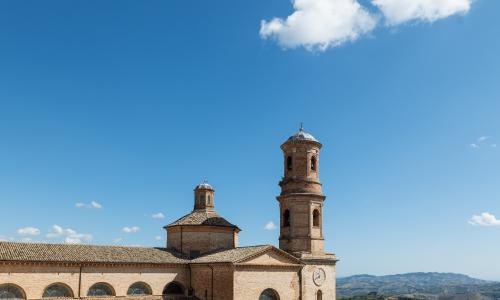
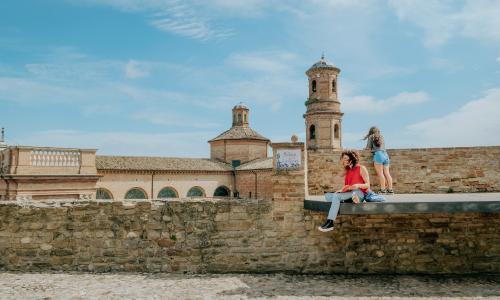
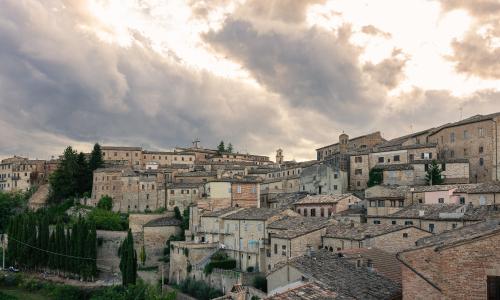
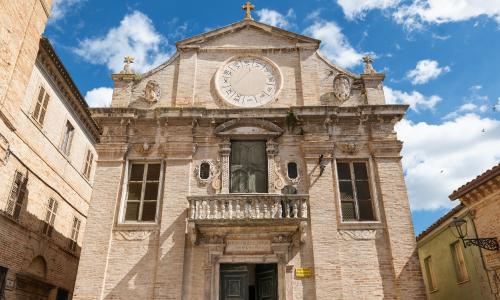
Throughout his life, he demonstrated great care for his hometown of Montalto delle Marche. As a cardinal, he authorized a weekly market—tradition still maintained every Wednesday morning—established a municipal doctor, and founded a gymnasium school. As Pope, he elevated Montalto to a city, created a new diocese, and instituted the “Presidato,” a territory of 17 municipalities governed by a President-Governor who also administered justice, including the ius sanguinis. He launched an ambitious urban development program, designing “New Montalto,” and to support this, he established a papal mint in the town and promoted the construction of the magnificent Co-Cathedral dedicated to the Assumption, where, according to his grand vision, the Holy Sepulchre of Jerusalem was to be relocated. He also ensured that promising but underprivileged young people could study by founding the Collegio Montalto in Bologna. Over more than two centuries, more than 1,300 jurists, doctors, mathematicians, theologians, and high-ranking prelates would be educated there. His deep affection for his fellow citizens is symbolized by the precious 14th-century Parisian goldsmith reliquary that Sisto V gifted for their care and protection, which the people of Montalto have always fiercely safeguarded.
The Sistine Pontificate (1585–1590) still impresses today for its brevity compared to the breadth, radicality, and complexity of the Pope’s actions within the ecclesiastical institutions, the liturgy, international political relations, urban planning, and construction. Not surprisingly, Sisto V’s determination became legendary. The Sistine Pontificate gave a strong boost to the social and economic reorganization of the Papal States, culminating in a radical modernization of Rome’s urban layout. It was precisely Sisto V who brought this transformation to life, earning him the title of “God’s Urban Planner.”